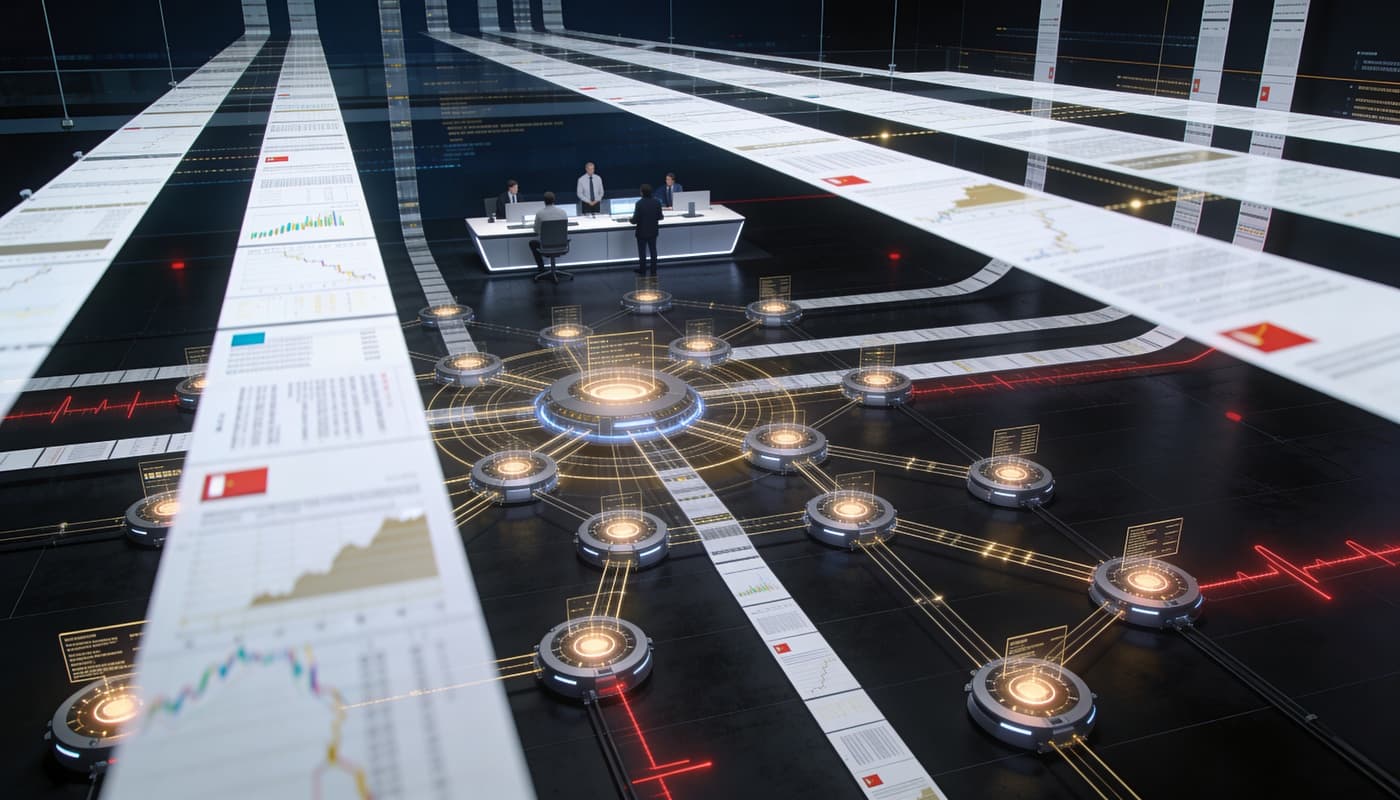
Safe AI Deployment: Why Topology Beats Model Choice
Every enterprise is being told to "deploy AI." Most of the conversation focuses on which model to use—Claude, GPT-5, Llama, Mistral, Gemini. That is the wrong first question.
The decision that actually determines your compliance posture, your cost curve, your capability ceiling, and how locked-in you are five years from now is not the model. It is the deployment topology—the architectural choice about where and how your AI workloads run.
There are four realistic options for getting production AI into an enterprise environment in 2026. Each one solves different problems. Picking the wrong topology will cost you more than picking the wrong model—and it will be much harder to reverse.
Why Topology Matters More Than Model Choice
Models change every six months. A new frontier model is released, then a competitor leapfrogs it the next quarter, then open-weight models close the gap. The conversation is constant, the pace is frantic, and the switching cost is low: you change a few lines of code and move to the new frontier.
Topology is different. Topology is a 3–5 year decision.
When you choose to self-host on your own GPU infrastructure, you are committing to hiring ML engineers, building monitoring and retraining pipelines, and absorbing the operational burden of a distributed system. When you go all-in on a cloud marketplace, you are betting your team's productivity on that cloud provider's roadmap and pricing. When you pick a direct API from a commercial vendor, you are accepting that your proprietary training data leaves your network on every single request.
The topology decision locks in four critical dimensions:
- Data sovereignty. Where does your data live? Does it stay in your network, your VPC, or does it leave the building on every API call?
- Capability ceiling. What models can you access, and how fast do new capabilities reach your applications?
- Cost structure. Is this a fixed cost (capex and engineering salary), a variable cost (per-token opex), or something hybrid?
- Lock-in. How easily can you switch vendors, change models, or unwind this decision in 18 months?
If you're reading this, you've probably already prototyped on a commercial API—ChatGPT, Claude, or Gemini directly. The question now is whether that's the production answer, or whether the economics and compliance profile of your enterprise demand something different.
The Four Real Options
Option 1: Self-Hosted Open-Weight Models
This is running Llama, Mistral, Qwen, or DeepSeek on your own GPUs (purchased or rented via cloud providers like AWS, Lambda Labs, or Crusoe).
The appeal: You control everything. Data never leaves your network. You can fine-tune on proprietary data. There is no vendor T&C that could change tomorrow. At very high token volumes, the marginal cost approaches zero—you own the infrastructure, so the 100 millionth token costs you almost nothing The Rise of Open-Source AI Models (2024 — 2025) | by Jonathan Lee | @justjlee | Medium.
The catch: The upfront and operational costs are severe. A single H100 GPU costs roughly $25,000–$40,000 to purchase outright, or $2–$4 per hour to rent. To run production inference at scale, you need multiple GPUs, plus load balancing, monitoring, vector databases, fine-tuning pipelines, and someone with genuine ML/MLOps expertise managing all of it.
Open-weight models also trail the commercial frontier by 6–18 months. The leading open-weight releases are genuinely strong, but they typically sit behind the latest closed frontier models on overall capability. By the time open-weight models reach parity on one capability, the closed models have moved forward on another. You buy sovereignty and control at the price of capability lag.
The math: Self-hosting breaks even only above very high token volume—typically 25–50 million tokens per day depending on your GPU strategy The State Of AI Infrastructure: Demand, Costs, And Custom Silicon. If you are using 2 million tokens per day, you will never recover your capex. If you are using 100 million tokens per day, self-hosting will eventually be cheaper than any commercial option.
Option 2: Direct Commercial API
This is going directly to OpenAI, Anthropic, Google, or Mistral and calling their API endpoints.
The appeal: Fastest to ship. You are on the capability frontier immediately. Zero infrastructure—no servers, no GPUs, no MLOps. Per-token pricing is straightforward and scales linearly. Easy to A/B test models (swap one API endpoint for another). Easy to add new models as they release.
The catch: Data leaves your network on every request. Your proprietary documents, customer conversations, internal code—all of it flows to a third-party API. Vendor terms-of-service govern whether your data is used for training, how long it is retained, and who else might see it. There is no enterprise IAM integration. For regulated industries (healthcare, finance, government), direct API is often a non-starter from a compliance perspective The CISO's New Mandate: Leading AI Governance in Healthcare | Censinet, Inc..
Procurement is messy. You cannot buy through your main cloud contract. Billing is separate. Compliance review is slower. And you have no volume discounts—per-token pricing never drops, no matter how much you spend.
The cost: Lowest startup cost. Mid-tier marginal cost. Scales linearly forever. If you are using 100 million tokens per day, you will be paying handsomely with no volume break.
Option 3: Commercial Models via Cloud Marketplace
This is AWS Bedrock, Azure AI Foundry, Google Vertex AI, or equivalent—your cloud provider's managed interface to commercial models.
The appeal: Data stays in your VPC. It never leaves your cloud region. You inherit your existing cloud compliance posture (HIPAA, FedRAMP, SOC 2). Single procurement and billing through your main cloud contract. IAM-native—same identity system your engineers already use. No rogue API risk. Models release within weeks to months of the direct provider.
This is becoming the enterprise default Google leader IDC MarketScape Hyperscaler Marketplaces | Google Cloud Blog.
The catch: You are all-in on one cloud's gravity. New model releases lag direct providers by weeks to months. Fewer models per cloud (AWS Bedrock has 20+ models, but Google Vertex might have 15; each curates). Marginal premium of 0–25% per token compared to direct API (you are paying slightly more for the compliance and IAM convenience).
The cost: Slightly higher per-token than direct API. Eliminates a separate vendor relationship and a compliance review. For most regulated enterprises, this is the lowest total cost of ownership when you account for procurement, legal, and compliance time.
Option 4: Hybrid via AI Gateway
This is a routing layer—Vercel AI Gateway, OpenRouter, or your own internal proxy—that sits between your application and whatever AI provider you choose. You write to the gateway's interface, and the gateway dispatches to the backend.
The appeal: Model portability without rewriting code. Single observability layer across all AI spending. Fallback between providers (if OpenAI is down, route to Anthropic). Central cost tracking and governance. Retains optionality—you can swap backends without touching application code.
The catch: Another component to operate. Does not solve data sovereignty by itself (depends on which backend you route to). Adds a hop of latency, though usually negligible.
The cost: Near zero marginal cost. Gateways are cheap or free. Saves money indirectly through routing intelligence, fallback prevention, and unified governance.
Comparison Matrix
| Dimension | Self-hosted | Direct API | Cloud Marketplace | Gateway Hybrid |
|---|---|---|---|---|
| Data sovereignty | Highest | Lowest | High (VPC-bound) | Depends on backend |
| Compliance fit (HIPAA, FedRAMP) | Strong | Weak | Strong | Inherits backend |
| Capability ceiling | Trails frontier | Frontier | Slight lag | Frontier (via backend) |
| Time to ship first use case | Weeks–months | Days | 1–2 weeks | Days |
| Cost structure | Capex + ops | Per-token opex | Per-token opex | Marginal opex |
| Cost at low volume | Very high | Lowest | Low | Lowest |
| Cost at high volume | Lowest | Highest | High | Mid |
| Operational burden | Highest | Lowest | Low | Low |
| Lock-in risk | Lowest | Highest | High (cloud) | Lowest |
The Decision Framework
Use this framework sequentially:
-
Is your data regulated? HIPAA, PCI compliance, FedRAMP for government, EU residency requirements—these eliminate direct API. Choose cloud marketplace or self-hosted.
-
Do you have ML/MLOps capacity? Self-hosting requires expertise most enterprises do not have. If you do not have engineers who have operated distributed inference systems, skip self-hosted.
-
Is your daily token volume above 30 million? This is the inflection point AI inference costs set to plunge: Gartner | CIO Dive. Below that, the capex and ops cost of self-hosting will never break even. Above that, the math flips.
-
Are you running multiple AI use cases across teams? One use case, one team, one model—you can hardcode an API endpoint. Five use cases, three teams, different models per feature—add a gateway. The observability, fallback routing, and cost attribution pay for themselves quickly.
-
Are you on a single major cloud already? If your compute, storage, and databases are on AWS, adding Bedrock is a no-brainer. If you are cloud-agnostic or hybrid, the gateway becomes more valuable.
Where This Is Going
The topology landscape is shifting fast. Three trends matter:
Cloud marketplaces will become the enterprise default. Bedrock, Foundry, and Vertex are already standardizing procurement, compliance, and IAM. The "direct API" pattern will increasingly be for startups and prototypes. By late 2026, the enterprise path will be: prototype on direct API (days to production), then migrate to cloud marketplace (weeks to months) as scale and compliance requirements emerge — a trajectory consistent with McKinsey's 2025 State of AI finding that 88% of organizations now use AI in at least one business function but only about a third have scaled it across the enterprise.
Open-weight models will close the capability gap. Llama 3.1 is already shockingly good. DeepSeek is moving fast. The price-quality premium on closed models is compressing. By late 2026 or early 2027, open-weight models will be within 6 months of the frontier on most benchmarks. This means self-hosting will pencil for many more workloads than today—probably at 10–15 million tokens per day instead of 30 million.
AI gateways will become standard middleware. Same trajectory API gateways did a decade ago. Every serious enterprise will eventually operate one, not for the latency cost (negligible) but for the observability, governance, and optionality it provides.
Agentic workloads will invert the economics. Today, one user request = one model call. With agents, one request generates 10–50 model calls. This will drive per-token volume up dramatically, making high-volume optimization matter more, not less.
The Architect's Starting Posture
If I were starting from zero in an enterprise today, here is what I would do:
- Default to cloud marketplace for compliance-inheriting ease and procurement simplicity. This is the path of least resistance for 70% of enterprises.
- Put a gateway in front of it on day one. The operational cost is near-zero. The optionality and observability are worth it.
- Reserve self-hosting for one or two narrow, high-volume, low-sovereignty-sensitivity workloads where the math obviously works. Do not self-host your chatbot. Do self-host your batch embedding pipeline if it runs 100 million tokens per day.
- Treat the model itself as a swappable component. Build your architecture so you can change from Claude to GPT-4 to Llama in a config change, not a rewrite. The model you choose today will not be the model you are running in 18 months.
The topology decision is the hard one. Once you make it, the model is easy.
Getting this decision right the first time saves years of rework and millions in operational overhead. If you are picking a deployment topology for the first time, or trying to course-correct from a direct-API prototype that needs to become production-hardened and compliant, that's the work we do at ClearPath Consultants. We help enterprises architect AI systems that scale safely, stay compliant, and do not lock you into the wrong vendor relationship. Contact us to discuss your topology strategy.

Senior Solutions Architect
Kavita is a full-stack technologist with deep expertise in cloud-native architecture, API strategy, and systems integration. She holds AWS and Azure certifications and has delivered digital transformation projects across healthcare, manufacturing, and financial services. She writes about the practical side of technology adoption — what works, what doesn't, and what's worth the investment.