AI-Native Engineering: Transforming Enterprise Delivery Models
The evolution of artificial intelligence in software development has reached an inflection point. What began as predictive text for developers has matured into a comprehensive reimagining of how engineering teams design, build, test, and operate enterprise systems. AI-native software engineering isn't simply about faster code generation—it's fundamentally transforming delivery models, team composition, governance frameworks, and the entire software development lifecycle.
Organizations that recognize this shift and adapt proactively will gain measurable competitive advantages. Those that treat AI tooling as a peripheral convenience will find themselves increasingly challenged by teams that have fully embraced AI-assisted architecture, testing, and incident response.
The Shift From Code Completion to Enterprise Architecture
Early AI coding tools captured headlines by promising faster individual productivity. GitHub Copilot and similar assistants undoubtedly accelerate routine coding tasks. But enterprise AI development has moved far beyond autocomplete suggestions.
Today's leading organizations are embedding AI throughout the entire architecture phase. Rather than waiting for developers to draft designs, AI tools now:
- Analyze existing codebases to identify architectural patterns, technical debt, and optimization opportunities
- Generate alternative design approaches for complex systems, allowing architects to evaluate tradeoffs before implementation
- Validate designs against organizational standards, ensuring consistency with enterprise governance policies
- Produce architecture decision records (ADRs) automatically, documenting reasoning and assumptions
This represents a fundamental change in how architectural decisions get made. What previously required weeks of design review cycles can now happen iteratively, with AI providing immediate feedback on feasibility, scalability implications, and alignment with existing systems.
For ClearPath's technology advisory clients, this shift demands a critical question: Are your architects positioned to leverage AI as a collaborative partner, or are they still manually producing artifacts that AI could validate and enhance?
Restructuring Teams for AI-Embedded Delivery
The composition of engineering teams is changing—not through reduction, but through reorientation. Gartner Says Generative AI will Require 80% of Engineering Workforce to Upskill Through 2027
Organizations implementing AI-native software engineering aren't eliminating developers; they're eliminating tedious, repetitive work and allowing developers to focus on higher-value activities. The practical effect is a shift in required skills:
What's Becoming Less Critical:
- Boilerplate code generation
- Routine testing of standard patterns
- Documentation of straightforward functionality
What's Becoming Essential:
- Prompting and evaluation of AI-generated solutions
- Critical assessment of AI recommendations and their long-term implications
- Integration of AI-assisted development with governance and compliance frameworks
- Advanced debugging and optimization of AI-suggested code
Teams are also becoming more cross-functional. AI-assisted testing tools enable backend engineers to write meaningful frontend tests without deep UI expertise. Architects can draft implementation code without it becoming a bottleneck. This breakdown of traditional silos accelerates enterprise delivery timelines.
However, this fluidity requires intentional governance. Without clear guardrails, AI-native teams risk generating technically functional but organizationally misaligned solutions.
Testing and Quality Assurance: AI as Quality Engineer
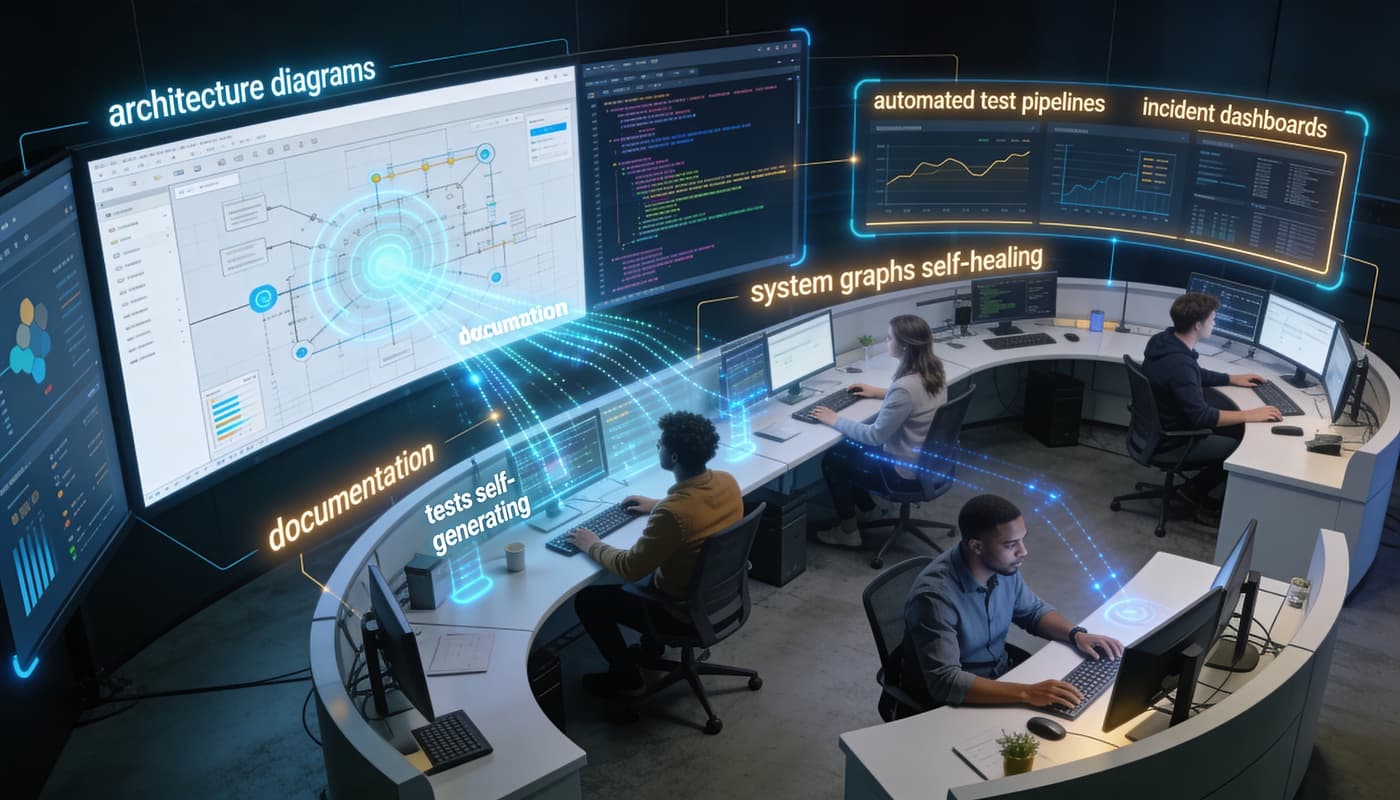
One of the most significant shifts happening in software delivery transformation is in testing. AI tools now generate comprehensive test suites, identify edge cases humans might miss, and flag potential security vulnerabilities during code review (PDF) AI in Testing Automation: Enabling Predictive Analysis and Test Coverage Enhancement for Robust Software Quality Assurance.
In practice:
- Test generation becomes automated: Developers input business requirements, and AI generates unit tests, integration tests, and even user acceptance test scenarios
- Coverage gaps are identified proactively: Rather than discovering incomplete test coverage during code review, AI flags it immediately
- Performance and security testing scales: AI can generate load test scenarios and penetration test approaches without manual effort
- Regression testing becomes continuous: AI continuously validates that changes don't break existing functionality
The implications for delivery models are profound. QA teams transition from scripting tests to designing test strategies, validating AI-generated test quality, and ensuring tests align with business requirements. The role becomes more strategic and less execution-focused.
Organizations that fail to evolve QA processes risk creating a false sense of security—their tests run faster, but might not be asking the right questions.
Documentation and Knowledge Management
Documentation has historically been the last thing teams complete, often inaccurate and quickly outdated. AI-native engineering changes this equation entirely.
AI tools now:
- Generate documentation in real-time as code is written, extracting intent from function signatures, comments, and logic flow
- Maintain current API documentation automatically, updating it whenever APIs change
- Create runbooks and playbooks for common operational scenarios
- Generate compliance documentation mapping code and infrastructure to regulatory requirements
For enterprises managing complex systems across multiple teams, this has immediate value. New engineers onboard faster. Institutional knowledge doesn't walk out the door when key people leave. Compliance audits become less burdensome.
The catch: organizations must establish quality standards for AI-generated documentation and maintain processes to validate accuracy. Documentation that's current but wrong is worse than no documentation.
Incident Response and Operational Resilience
Enterprise AI development extends beyond the development phase into operations. AI-native incident response represents one of the most practical, immediately valuable applications How AI Is Transforming Observability and Incident Management in 2026 | Xurrent Blog.
When incidents occur:
- Root cause analysis accelerates: AI analyzes logs, metrics, and system events to identify probable causes
- Remediation options are suggested: Rather than engineers guessing at fixes, AI recommends solutions based on similar past incidents
- Postmortem automation: AI drafts incident reports, identifying patterns across incidents
- Preventive measures emerge automatically: System vulnerabilities are identified and flagged before they become critical
Teams move from reactive firefighting to strategic response optimization. This has measurable business impact—reduced mean time to resolution (MTTR), faster recovery, and fewer escalations.
Governance and Risk Management
The introduction of AI throughout the SDLC creates new governance challenges. Organizations need:
- AI model governance: Which AI tools are approved? What are their limitations? When should developers override AI suggestions?
- Security and compliance validation: How are AI-generated code and infrastructure changes vetted against security standards?
- Vendor lock-in assessment: Does increasing reliance on specific AI platforms create strategic risk?
- Transparency and explainability: Can you explain why AI suggested a particular architectural approach?
Without these frameworks, organizations risk rapid delivery of lower-quality solutions that create future technical debt.
Moving Forward
AI-native software engineering is reshaping how enterprises deliver technology solutions. Teams that embed AI throughout their delivery models—from architecture through incident response—are gaining measurable advantages in speed, quality, and team satisfaction.
The practical question isn't whether to adopt AI-native practices, but how to do so strategically, with appropriate governance, and in ways that align with enterprise risk tolerance.
ClearPath Consultants helps organizations navigate this transformation. Whether you're assessing your engineering team's readiness for AI-native practices, designing governance frameworks for AI-assisted development, or restructuring delivery models to leverage these tools effectively, our advisors bring experience from enterprise transformations across industries.
Ready to evaluate how AI-native software engineering could reshape your delivery capability? Let's explore what's possible.

Chief Technology Officer
Raymond brings over 15 years of experience leading enterprise technology transformations. Before joining ClearPath, he architected cloud migration strategies for Fortune 500 companies and led engineering teams at two successful SaaS startups. He specializes in helping mid-market businesses modernize their technology infrastructure without disrupting operations.